
Banks are in a tight spot as ministry wants them to open ATMs at all rural branches

Banks have raised concerns over the new international trade settlement in rupee, fearing that facilitation of such a mechanism could result in them facing the ire of economic sanctions by the West, people aware of the matter said. Large banks with overseas operations have sought clarity and assurance from the Reserve Bank of India (RBI) that they will not be targeted with sanctions for facilitating rupee trade with a sanction-hit country such as Russia. The present payment mechanism is a shift from earlier such arrangements, like the one with sanction-hit Iran, which involved banks facilitating settlement of international trade that did not have business in the sanctioned nation.

In mid-March this year, the finance ministry asked state-run banks to review their gold loan portfolio for the two-year period between January 1, 2022, and January 31, 2024. This business had grown at a fast clip. Reserve Bank of India (RBI) data has it that it grew 15 per cent to Rs 1 trillion in FY24. Now, in recent times, any kind of exuberance in financial services has seen the authorities swoop down - be it pushing the lines on governance or unsecured credit.

RBI had a board meeting recently.

'Das is friendly, but he finally does what he does. The quality of engagement is very good.'

The remarks came amid reports of mounting tension between the finance ministry and the RBI over the autonomy of monetary policy makers.

'The dakiyas will be our partners, receiving credit proposals from micro-enterprises at the grassroots level.'

After making a larger-than-expected cut of 50 basis points on September 29, Rajan urged the federal government to do its bit to accelerate growth through structural reforms.

Subramanian, a senior fellow at the Peterson Institute for International Economics in Washington, attended a news conference in New Delhi at which his appointment was announced.

For the first time, PSU banks will have a non-executive chairman, giving operational responsibility to managing director and chief executive officer.

The Indian economy will grow at around 6.5 per cent in the current fiscal, notwithstanding high crude oil prices and increased uncertainty due climate changes, NITI Aayog member Arvind Virmani said on Thursday. Virmani also asserted that the gross household savings ratio in India has consistently gone up. In an interview with PTI, he said: "My growth projection (of India's GDP growth) is 6.5 per cent plus minus 0.5 per cent... because my experience is that the fluctuations in global GDP more or less has balanced out for us, assuming normal changes."

Lenders in India, comprising banks and finance companies, anticipate robust growth in retail credit during the upcoming festival season, stretching from September to December 2023. This expectation is based on resilient demand, government initiatives, and elections in key states.

An executive director of a bank could, for example, be elevated to the post of chairman of a different bank.

The Fintech Association for Consumer Empowerment (FACE), the only self-regulatory organisation for financial technology/fintech (SRO-FT) companies, is aiming to secure membership from at least 75 per cent of players across all key fintech categories within the next three years, according to a senior executive. The total number of members in the organisation has increased to 110, up from around 60 when it received approval from the Reserve Bank of India (RBI) to operate as an SRO-FT in August.

Central Bank of India's 21.5 per cent assets are either bad or have been restructured.

'The committee has been constituted. Different government departments and FSDC members are part of it.'

RBI staff tell Governor Urjit Patel that the central bank's image of efficiency and independence has 'gone into smithereens in no time.'

The post of chairman and managing director has been split and the government has appointed managing directors and chief executive officers in four banks -- Indian Overseas Bank, United Bank of India, Oriental Bank of Commerce and Vijaya Bank.

The central government and the Reserve Bank of India have devised a country-specific plan towards implementation of overseas trade in rupee, people aware of the matter said. To start with, a small number of banks will be allowed to manage cross-border transactions in domestic currency with a particular country. "Small countries that are dollar-deficient have shown interest in doing trade in rupee.

Reserve Bank has lowered interest rates by 0.50 per cent since January 2015.

Finance Minister Nirmala Sitharaman is scheduled to meet heads of public sector banks (PSBs) next week to review performance of the lenders and progress made by them to support the economy battered by the COVID-19 pandemic. Banks would be urged to sanction loans for productive sectors to accelerate revival of the economy, sources said. According to sources, the two-day meeting would commence on November 17 and undertake a comprehensive review of various segments, progress in government schemes including Aatmanirbhar Bharat Abhiyan.

Prices may go up because of higher energy costs, caused by the rise in shipping charges, with commercial vessels taking a longer route to avoid the troubled Red Sea region, the finance ministry said on Monday. Iran-backed Houthi rebels of Yemen are repeatedly attacking ships in the Red Sea. While the global economy is grappling with challenges such as sticky inflation, sluggish growth, and mounting fiscal pressure, India's external sector could face "potential risks" due to the ongoing geopolitical tensions, according to the finance ministry's report on the review of the Indian economy.
In a draft paper prepared by the RBI seeking public opinion until January 18, the banking regulator has proposed a financial instrument linked to gold to curb the demand of its physical holding.

India's foreign exchange reserves are at an all-time high.

Bad loans of PSBs are at Rs 20 trillion. Most of it is, I sense, due to corruption and behest lending. Nobody pays a price for this charade. Not the promoters, the bankers, RBI officials, finance ministry bureaucrats or politicians, points out Debashis Basu.

Reservations expressed by the Reserve Bank of India (RBI) notwithstanding, North Block, the finance ministry headquarters, is going ahead with its plans to set up a full-fledged Debt Management Office (DMO) to manage the government debt.
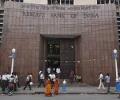
At a time when the asset quality of state-owned banks is deteriorating, the Reserve Bank of India is also planning harsher penalties for wealthy promoters of wilful defaulters.

Despite its admirable competence and proven track record, the RBI doesn't have the capacity to supervise an economy that's growing so fast and becoming larger by the year, points out T C A Srinivasa Raghavan.

Tata Steel was the top laggard in the Sensex pack, cracking over 6 per cent, followed by SBI, IndusInd Bank, HDFC, ICICI Bank and ONGC. Bajaj Auto, Maruti and Asian Paints were the only gainers.

Improved monsoon, solid fiscal performance, and capex push by the public and private sectors augurs well for India's macroeconomic stability and growth, the finance ministry's monthly economic review for June 2023 said. But the report said that while India's domestic fundamentals remain strong, negative cross-border spillovers and adverse global developments could act as a deterrent in achieving the high growth path this financial year. "An improved matching of aggregate supply and aggregate demand in the Indian economy underpins the progress made in the control of domestic inflation and the consequent strengthening of macroeconomic stability," the review said.

The committee's suggestion that existing commercial banks be allowed to hold payment banks as subsidiaries is also seen as unviable by RBI and the finance ministry.
With an aim to safeguard the investors from possible frauds involving collective investment schemes, the government has proposed a high-level committee of members from Reserve Bank, Sebi, Corporate Affairs Ministry and Economic Office Wing of state police departments.
The immediate priority for the new governor will be to draft the mid-quarter review

Ahead of the Union Budget, the banking sector, through the Indian Banks' Association (IBA), has made recommendations to the Union finance ministry on direct tax, including removing Section 194N of the Income Tax Act. According to Section 194N, tax deduction at source (TDS) has to be done if a sum or sums withdrawn in cash by a person in a fiscal year exceed Rs 20 lakh if no income-tax return (ITR) has been filed for the three previous assessment years, and Rs 1 crore if ITRs have been filed in all the three previous assessment years.

It is also considering to hike FDI cap for public sector from 20 per cent to 49 per cent
Batting for the Reserve Bank of India and the finance ministry, the Planning Commission on Friday said concessions to special economic zones should be at par with those provided to infrastructure projects.\n\n

The highest-ever goods and services tax (GST) evasion has been done by the online money gaming industry.

RBI lends and borrows money from banks against government securities under this facility.
 © 2026 Rediff.com - Advertise with us - Disclaimer - Privacy Policy - Sitemap - Feedback - About us - Terms of use - Grievances